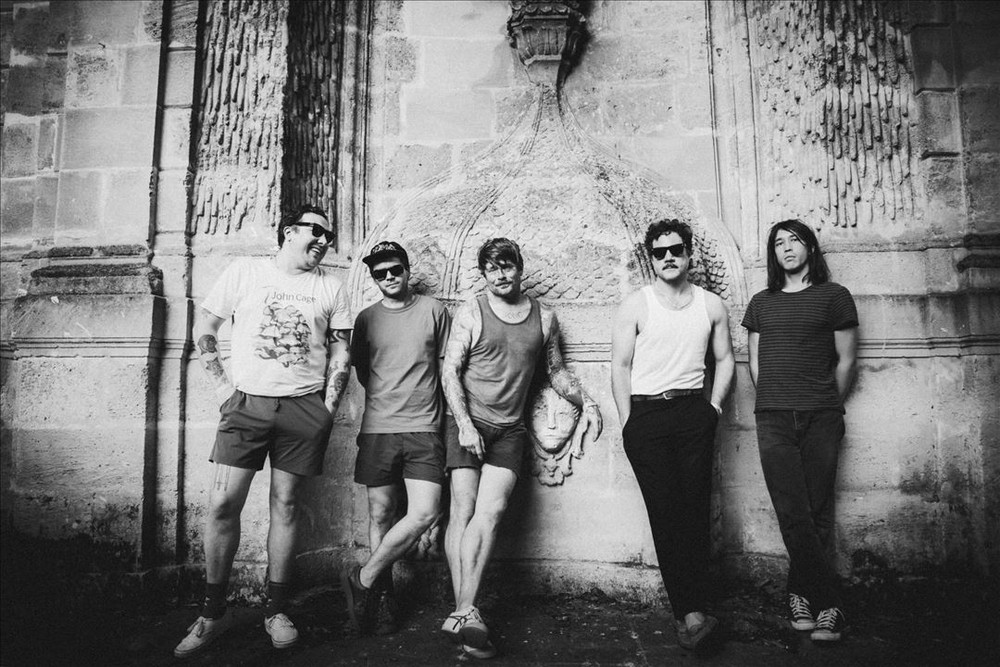
acid rock · egg punk · garage rock · grunge · indie punk at 143 BPM
On the run
La Luz released "It's Alive" on Hardly Art in 2013. Same year, Allah-Las dropped their self-titled on Innovative Leisure. 2014 brought The Murlocs' "Loopholes" on Flightless Records and Meatbodies' debut on In The Red. Seattle, Los Angeles, Geelong, Australia, Los Angeles again — no shared producer, no common label, no coordination. Yet every single one of them landed on the same reverb-drenched, mid-tempo architecture: 60s California surf and psych filtered through the economics of bands who couldn't afford to sound expensive. That's the gravitational field HERMOSA orbits.
The choice was structural nostalgia as survival strategy. Borrow the warmth of a Hermosa Beach afternoon, strip out the budget that originally built it, and discover that the skeleton beneath sounds better without the flesh. These artists — in Perth, Chicago, Washington D.C., Zion, Illinois — reconstructed a golden-California sound in cities that weren't California. The copy turned out to be more durable than the source. A copy without the source, which runs indefinitely at 140–150 BPM.
That tempo isn't arbitrary. Reverb-forward, sun-damaged garage rock has always had one natural pace — the speed of a run along a coast you don't live near. Shannon & The Clams' "Runaway" sits at the same BPM center as Psychedelic Porn Crumpets' "Cornflake" because the architecture demands it. Teen Mortgage in "Doctor," Gee Tee in "FBI," Frankie and the Witch Fingers in "Futurephobic" — they all converged on this tempo not because anyone coordinated, but because the sound itself has structural gravity.
The consequence is a playlist where every track orbits the same center. levitation room's "Warmth of the Sun" bleeds into Bass Drum of Death's "Shattered Me" with zero friction because both are built on the same skeleton. Local H closes with "California Songs - 2024 Remaster" — a band from Zion, Illinois singing about California in 1996, remastered in 2024, still sounding like they never left the Midwest. That's the point. The California these artists reconstructed was always more real than the original.
From the coach
Let the BPM build you, then hold through the drop
Hold conversational pace through the first three tracks. The BPM sits around 148, but don't chase it yet. Let your heart rate settle into the reverb wash. You're building the base.
Tracks 4 through 6 jump to 155 BPM. This is where you open the stride. Push into tempo pace — controlled, not reckless. Your breath should land every four steps. Hold it through the FBI close.
Tracks 7 through 9 drop to 127 BPM. Recover here. Active rest — don't stop moving, but let your heart rate come down. The playlist gives you permission.
Tracks 10 through 12 spike back to 157 BPM. This is your hardest push. You'll hit the cognitive wall around track 13 — "Loopholes" — right at the 66% mark. That's not your legs failing. That's your brain lying to you. Anchor to the drum pattern and hold your turnover. The tempo will carry you if you let it.
Tracks 16 through 18 cool you down at 123 BPM. Ease out. You've already done the work.
FAQ
- How do I pace a run to this playlist?
- Start easy through 'Hardly Art, Canvasback, Flightless' — let La Luz and The Orwells establish the reverb field before your legs commit. Lock in during 'The 145 BPM Lock' where Shannon & The Clams through Gee Tee hold the same tempo for four straight tracks. By 'Skate Punk Bleeds Into Garage,' you're not thinking about pace anymore — FIDLAR and Bass Drum of Death just carry you home.
- What type of run is HERMOSA best for?
- Mid-distance steady state — 5 to 8 miles where you settle into a groove and stay there. The playlist doesn't spike or dip; it holds 140–150 BPM almost the entire way through. Perfect for a Saturday morning run where you're not racing, just moving. The 58-minute runtime matches a comfortable 9–10 minute mile pace perfectly.
- Why does this BPM range work so well for running?
- The playlist averages ~143 BPM, which maps almost exactly to a 170–180 step-per-minute cadence if you're hitting every other beat. That's the sweet spot for most recreational runners — fast enough to feel propulsive, slow enough to sustain for an hour. The Murlocs, Osees, and Psychedelic Porn Crumpets all naturally write in this range because garage-psych has always had one tempo: the speed of a coast you're chasing.
- What makes 'Loopholes' the key moment in this playlist?
- It arrives at track 16, two-thirds through, when your body has stopped negotiating. The Murlocs recorded it for Flightless Records in 2014, and Ambrose Kenny-Smith's harmonica cuts through the reverb like you've been running toward it the whole time. The tempo hasn't changed, but your stride locks into it completely. It's the moment the playlist's thesis becomes physical.
- What makes Pacific Rim garage-psych good for running?
- It's music built on the skeleton of California surf and psych, but recorded by bands in Seattle, Melbourne, Perth, Chicago — cities that never had the budget or the weather. The sound is nostalgic but structurally economical: reverb-soaked, mid-tempo, no expensive production. That architecture naturally holds a running pace. You're chasing a coast you don't live near, and the music knows it.
- Why does this playlist end with a Local H remaster?
- Because 'California Songs' was recorded in 1996 by a band from Zion, Illinois, remastered in 2024, and it still sounds like they never left the Midwest. That's the whole point of HERMOSA: the copy outlasts the original. Local H reconstructed California from a place that wasn't California, and 28 years later, it's more durable than the source. A copy without the source, which runs indefinitely.